
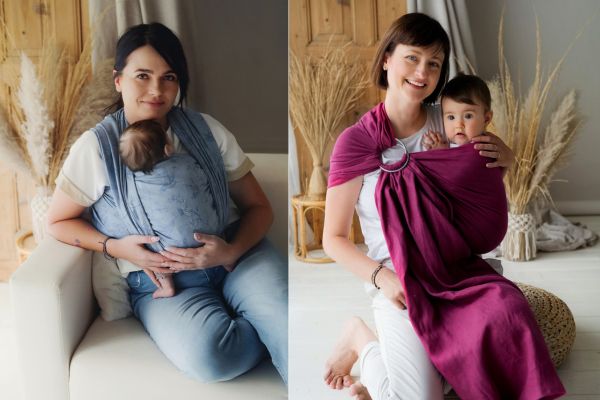
Snuggled close against your chest, comforted by your heartbeat, while you keep both hands completely free—babywearing is hands-down one of the most rewarding and practical lifesavers of early parenthood. But when you start exploring the babywearing world, the jargon can feel overwhelming: broken twill, jacquard, GSM, blends, base size, ring sling, or stretchy wrap...
Wondering which baby wrap to choose for a stress-free start? In this beginner’s guide, we break down the must-know essentials step-by-step so you can pick your very first wrap with total confidence and peace of mind.
How Soon Can You Wear a Newborn in a Wrap?
In a properly fitted, well-tightened woven wrap, you can safely wear your baby from day one.
A newborn’s anatomy is completely different from an adult’s. Their spine isn't straight yet; it rests in a gentle, natural curve resembling the letter “C” (total kyphosis). A supportive woven wrap honors this delicate developmental stage perfectly:
- Relieves pressure on their delicate body: Your baby isn't sitting on their tailbone or bearing their own weight. The wrap acts like a supportive hammock, distributing pressure evenly across their entire back and torso.
- Promotes healthy hip development: Legs rest in the orthopedic "M-position" (spread-squat position, where knees are raised higher than the bottom). This deep squat supports optimal acetabular cup development and is officially recommended by pediatric orthopedic specialists to help prevent hip dysplasia.
- Keeps airways clear and open: Resting upright against your chest keeps your newborn's chin from slumping down, protecting vital airflow and encouraging effortless breathing.
Good to know: Even the best buckle carrier can't contour around a tiny newborn's delicate frame with the strand-by-strand precision of a woven wrap. That's why in those first crucial fourth-trimester weeks, a woven wrap remains the gold standard in ergonomic infant care.
1. Types of Baby Wraps: Which One Fits Your Lifestyle?
There are three main categories of baby wraps on the market. Each serves a unique purpose depending on your baby's age and your daily routine:
A. Long Woven Wrap – The Ultimate All-Rounder
The timeless foundation of babywearing. Crafted from specially woven fabrics that do not stretch lengthwise or widthwise, but offer balanced diagonal give (cross-diagonal stretch).
- Best for: Newborns (including preemies with medical guidance) all the way through toddlerhood (up to 35–45 lbs / 3–4 years old).
- Why you'll love it: Provides unmatched head and spinal support, allows strand-by-strand precision tightening, distributes baby’s weight evenly across both shoulders and your back, and supports front, hip, and back carries.
- Go-to carries: Front Wrap Cross Carry (FWCC), Kangaroo Carry, and Ruck Sack Carry (on the back).
B. Ring Sling – The Quick-Trip Champion
A shorter length of woven wrap fabric (approx. 6.5–7 feet / 2 meters) threaded securely through two tested aluminum rings.
- Best for: Newborns up to active toddlers (up to approx. 33 lbs).
- Why you'll love it: Zero knots required! Simply tighten the fabric through the rings. It goes on in under a minute, packs down neatly in a diaper bag, and is a lifesaver for curious toddlers who constantly alternate between "Up, please!" and walking on their own.
- Keep in mind: Carries weight asymmetrically over one shoulder. It's fantastic for nursing on the go, quick store runs, and school drop-offs, but you'll want to switch sides periodically during longer walks.
C. Stretchy Wrap – The Cozy 4th-Trimester Option
Made from soft, t-shirt-like 100% cotton knit jersey.
- Best for: Newborns and small infants (typically most comfortable up to 15–18 lbs).
- Why you'll love it: You can "pre-tie" the wrap on your body before tucking baby inside, which lowers the learning curve for anxious first-time parents.
- Drawbacks: As baby gains weight, the knit stretches and sags, pulling on your shoulders. It always requires three layers across baby's back, which can easily cause overheating in warm American summers.
2. What Size Woven Wrap Should You Choose?
Woven wraps are sized by length. Your choice depends primarily on your adult shirt/dress size and the carry you plan to learn first (a Front Wrap Cross Carry requires more fabric than a simple Kangaroo carry).
| Wrap Size | Length (Meters / Feet) | Recommended Wearer Size & Usage |
|---|---|---|
| Size 4 (S) | 3.6 m (11.8 ft) | Petite wearers (US size 0–4 / XS–S) for Kangaroo and Ruck carries. |
| Size 5 (M) | 4.2 m (13.8 ft) | Petite wearers for FWCC, or average build (US size 6–8) for shorter carries. |
| Size 6 (L) | 4.6 m (15.1 ft) | The universal "Base Size" for beginners! Fits most mothers (US dress size 6–12 / M–L) and fathers for standard Front Wrap Cross Carries. |
| Size 7 (XL) | 5.2 m (17.1 ft) | For plus-size wearers (US size 14+), taller parents, or broader dads who want plenty of tail length to tie securely. |
Pro-Tip for Sharing Parents: If both mom (e.g., US size Small) and dad (US size Large/XL) plan to share one wrap, Size 6 (4.6 m / 15.1 ft) is your golden sweet spot. Mom will just have slightly longer tails, while dad will still have plenty of fabric to tie a safe, double knot.
3. Weave Types: The Secret to Effortless Tightening
Standard craft cotton or bedsheet fabric only stretches along straight grainlines, making it stiff and unsafe for ergonomic wrapping. Little Frog wraps are produced using specialized diagonal-weave looms:
- Broken Twill (Cross-twill / Stripes): The gold standard for beginners. It stretches diagonally without sagging, making strand-by-strand tightening remarkably forgiving.
- Jacquard Weave (Hearts, Botanicals, Geometrics): Allows intricate artistry and soft textures. Jacquard wraps feel cloud-soft and moldable right out of the box with virtually zero breaking-in required.
- Herringbone Weave: Incredibly airy, elegant, and drapeable. Provides exceptional grip (cush) on the shoulders while remaining light and breathable.
4. Fabric Blends: Pure Cotton or Fiber Blends?
Your blend choice determines temperature regulation, cush on the shoulders, and laundry care:
- 100% Combed Cotton: The absolute best choice for your first wrap. It's machine-washable, resilient, forgives minor wrapping mistakes, and gets softer with every wash and wear.
- Cotton + TENCEL™ Lyocell: A high-performance botanical fiber made from sustainably sourced wood pulp. Exceptionally silky, hypoallergenic, and moisture-wicking. Offers a built-in cooling touch that feels amazing in humid summer climates.
- Cotton + Linen: Linen brings incredible tensile strength and breathability. It doesn't stretch out under heavy toddler weights, making it a favorite for children 20+ lbs (though it benefits from a good steam iron after washing).
- Cotton + Bamboo: Adds instant velvet-like softness and a gentle drape, ideal for preemies and newborns with delicate, sensitive skin.
5. Fabric Weight (GSM): How Thick Should Your Wrap Be?
Fabric density is measured in grams per square meter (GSM / oz per square yard). It tells you how thick the wrap feels in hand:
- 190–220 GSM (Lightweight / approx. 5.6–6.5 oz/yd²): Airy and featherlight. Extremely easy to manipulate in small hands, ideal for summer newborns.
- 240–260 GSM (Medium Weight – The Beginner Sweet Spot): The most versatile weight on the market. Gentle enough for a 7 lb newborn, yet supportive enough that it won't dig into your shoulders when your baby hits 20 lbs.
- 280+ GSM (Toddlerworthy / Heavyweight): Dense and cushiony for heavier toddlers, but requires a bit more technique and finger grip to tighten smoothly.
Beginner Hack: Pick a Striped Wrap!
If you're brand new to wrapping, look for striped designs with distinct color rails (top and bottom edges).
Why? When the top rail is blue and the bottom rail is yellow, you immediately know which strand tightens the neck support and which one secures the seat under the knees. If you feel slack behind baby's neck, you simply tug the matching color. It cuts your learning curve down to minutes and eliminates early frustration.
Safety First: Master the T.I.C.K.S. Checklist
Every time you finish tying your wrap, run through the internationally recognized T.I.C.K.S. babywearing safety checklist:
- T – Tight: The wrap must be snug enough to hug your baby close. When you lean forward slightly, baby should stay flush against your chest without slumping.
- I – In view at all times: You should always be able to see your baby's face just by glancing down. Fabric must never cover their nose or mouth.
- C – Close enough to kiss: Your baby’s head should be resting high on your chest—close enough that you can kiss the top of their head simply by tipping your chin down.
- K – Keep chin off the chest: Ensure there is at least one to two fingers of clearance between your baby’s chin and their chest to prevent airway restriction.
- S – Supported back: Baby's back should be supported in its natural "C-curve," resting tummy-to-chest without being flattened against a stiff board.
What Should Baby Wear in a Wrap?
Always remember the golden rule of babywearing: the wrap counts as at least one full layer of clothing, and your own body heat acts as a natural heater.
- Avoid overheating: Indoors, a simple onesie and cotton pants are plenty. Skip bulky fleece suits, thick parkas, or puffy snowsuits, which prevent healthy hip flexion and stop you from achieving a snug, safe wrap.
- Watch out for footie pajamas: In a deep squat position, footie sleepers can tighten against tiny toes, curling their feet and triggering an involuntary grasp reflex. Opt for footless rompers paired with cozy socks or soft booties instead.
- Protect exposed extremities: Shield their head, exposed calves, and feet from direct sun with a breathable wide-brim UV hat in summer, or warm merino booties and knit beanies in winter.
Certified Safety and European Craftsmanship
Your wrap spends hours right against your infant’s skin, and teething babies frequently suck on the wrap rails.
Little Frog wraps are ethically manufactured in Poland under stringent safety guidelines:
- Certified under OEKO-TEX® Standard 100 (Class 1)—the most rigorous certification worldwide, guaranteeing zero toxic dyes, pesticides, heavy metals, or formaldehyde.
- Engineered in full compliance with ASTM F2907 (US Safety Standard for Sling Carriers), CPSC guidelines, and European standards EN 13209-2 & CEN/TR 16512.
- Acknowledged as a "Hip-Healthy" product following guidelines established by the International Hip Dysplasia Institute (IHDI).
Summary: The Perfect Starter Wrap Setup
Ready to start your babywearing journey? Here is our foolproof beginner recommendation:
- Style: Long woven wrap
- Length: Size 6 (4.6 m / 15.1 ft)
- Fiber: 100% combed cotton or cotton with bamboo / TENCEL™ lyocell
- Pattern: Striped with distinct color rails (or soft herringbone/jacquard)
- Fabric Weight: 240–260 GSM (Medium weight)
Still unsure which blend or length fits your postpartum needs, or need guidance mastering your first carry? Reach out to our certified babywearing educators or drop us a message—our Little Frog family is honored to help you and your little one snuggle close and thrive!